Image: Wikipedia / Wikimedia Commons
Image: Wikipedia / Wikimedia Commons
Istanbul stands as Turkey's beating heart and one of the world's most captivating cities, a place where nearly sixteen million people navigate the intersection of history, commerce, and daily life across two continents. This sprawling metropolis serves as the economic and cultural nucleus of Turkey, drawing visitors and migrants alike to its shores for centuries. The city's position spanning Europe and Asia, combined with its layered past as Constantinople and later as the Ottoman capital, gives Istanbul a character unlike anywhere else on Earth.
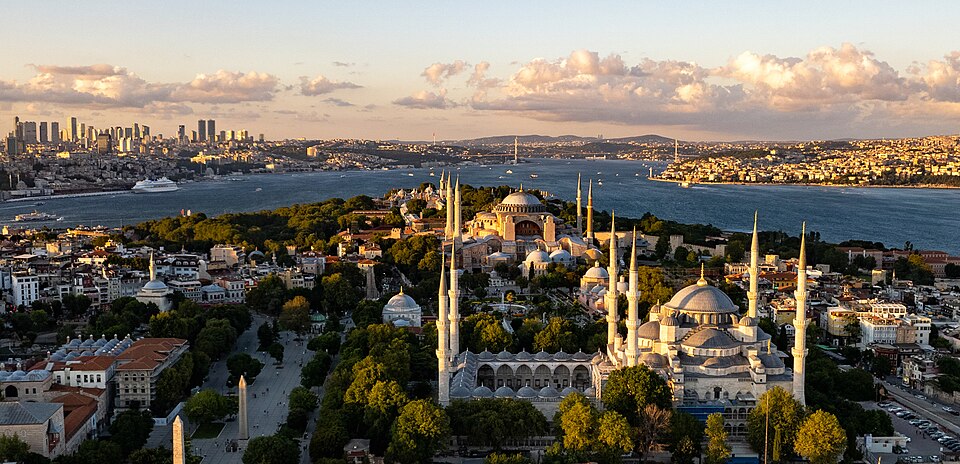
Straddling the Bosphorus at coordinates 41.01384N, 28.94966E, Istanbul occupies a strategic position in northwestern Turkey that has shaped its destiny since ancient times. The city sits at a modest elevation of 39 meters above sea level, positioned between two major water bodies: the Sea of Marmara to the south and the Black Sea to the north. The Bosphorus itself, one of the world's busiest maritime waterways, divides Istanbul into its European and Asian portions, with roughly two-thirds of the city's population residing on the European side and the remainder across the straits in Asia Minor.
This geographic division creates a unique urban experience. The Bosphorus is far more than a boundary; it is a living waterway constantly threaded with cargo ships, ferries, and fishing vessels. The passage between Europe and Asia takes only minutes by water, yet the crossing represents one of the most significant geographic transitions on the planet. Istanbul's total area spans 5,461 square kilometers, making it a sprawling metropolis with distinct neighborhoods and microclimates. The city's timezone is Europe/Istanbul, reflecting its transcontinental status.
Istanbul's historical weight is impossible to overstate. As Constantinople, it served as the capital of the Byzantine Empire for over a thousand years, accumulating religious, architectural, and artistic treasures that remain visible throughout the city today. When the Ottoman Empire conquered the city in 1453, it became the sultans' seat of power and remained the Ottoman capital until the early twentieth century. This layering of empires—Greek, Roman, Byzantine, and Ottoman—has left the city with an extraordinary archaeological and architectural palimpsest.
The physical evidence of these eras surrounds visitors everywhere. The Hagia Sophia, originally built as a Byzantine cathedral, later became a mosque, then a museum, and today functions once again as a mosque, embodying the city's complex religious and political history. The Topkapi Palace served as the administrative and domestic center of Ottoman power, while the Blue Mosque, built in the seventeenth century, remains an active place of worship and a stunning example of classical Ottoman architecture. The walls that once protected Constantinople still stand in parts of the city, crumbling reminders of medieval defensive engineering. Less monumental but equally important are the hammams, covered bazaars, and residential neighborhoods that preserve daily life from centuries past.
The historic districts of Sultanahmet and Beyoglu form the primary focus for visitors exploring Istanbul's cultural landscape. The waterfront areas, particularly along the Golden Horn and the Bosphorus, offer walking routes that provide both contemplation and discovery. Many neighborhoods reward unhurried wandering: the narrow streets of Balat with their old Greek and Jewish heritage, the bohemian quarters that have sprouted in recent decades, the residential areas where ordinary Istanbulites navigate markets and teahouses.
Beyond the central districts, Istanbul extends to both the European and Asian shores of the Bosphorus, each with distinct character. The Asian side, less densely visited by tourists, offers a different perspective on urban life and several significant historical sites. The city's relationship with water is fundamental—the shoreline, whether along the Sea of Marmara, the Bosphorus, or the Golden Horn, provides essential breathing space within this densely populated metropolis. Boating on these waters, whether via public ferries or private excursions, offers one of the most authentic ways to experience Istanbul's geography. The city's museums, libraries, and cultural institutions document everything from Ottoman manuscripts to contemporary art, reflecting Istanbul's role as a center of knowledge and creativity.
Istanbul is well connected to the rest of the world through multiple airports, with major international carriers serving the city regularly. Overland routes from Europe and Asia Minor converge here, and ferry connections link Istanbul to nearby coastal towns. Within the city, public transportation includes a metro system, trams, buses, and extensive ferry networks. The ferries, in particular, are both practical transportation and a way to experience the city's relationship with water.
With approximately 15.7 million people, Istanbul accounts for roughly eighteen percent of Turkey's total population, making it vastly larger than any other Turkish city. This concentration of humanity has made Istanbul the undisputed economic engine of Turkey, home to the majority of the country's financial institutions, manufacturing operations, and service industries. For people who live here, Istanbul is simultaneously exhausting and exhilarating—a place where opportunity and cultural vitality coexist with traffic congestion and housing pressures. The city's neighborhoods maintain distinct identities, from working-class residential areas to upscale districts, from recently gentrified zones to long-established ethnic and religious communities. Daily life in Istanbul involves negotiating crowds, navigating between continents, and participating in a consumer and cultural economy that operates at considerable intensity.
Istanbul demands time and patience to reveal its depths, but those who engage with the city's geography, history, and contemporary life find themselves in one of the world's most dynamic and historically resonant places.
View larger map — © OpenStreetMap contributors